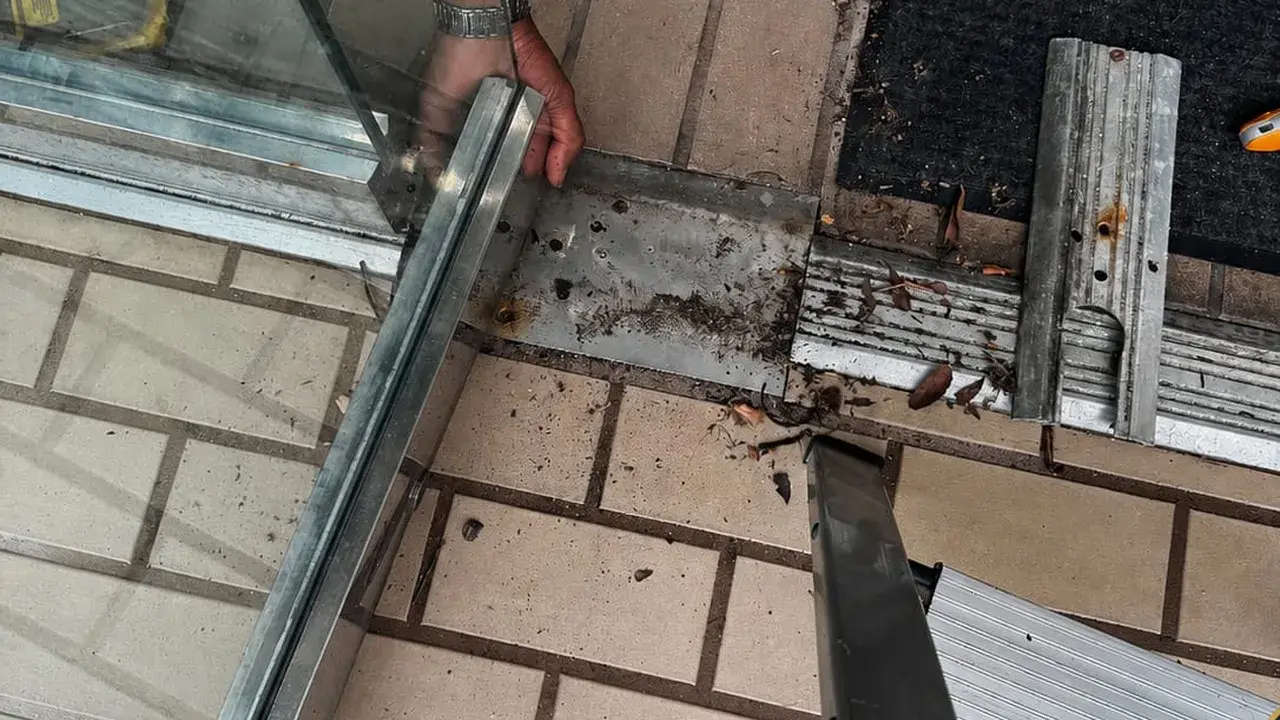
Every sliding door starts life moving on one finger, and every neglected one ends up a two-handed workout. Between those states is a progression so consistent that an experienced technician can usually guess the cause from the homeowner's description alone. Here is the progression, cause by cause, in the order the causes usually appear.
Cause 1: A dirty track
The first thief of glide is simple filth. The track is a ground-level trough in a high-traffic opening; it collects sand, grit, pet hair, food debris and, near pools and coasts, salt and minerals. Wheels rolling through that mixture grind it into the riding surface and their own bearings. A door that has gotten gradually heavier over a season or two, with a gritty sound, is often just dirty — and this is the one cause a homeowner can genuinely fix alone: vacuum the track, scrub it, pick the compacted debris from the corners, and feel the difference. If the difference is small, the problem has already moved deeper.
Cause 2: Worn rollers
The rollers carry the panel's entire weight on two small wheels, and they wear: nylon wheels flatten and crack, steel wheels pit and rust, bearings dry out and seize, housings fatigue. A door on worn rollers does not roll — it is dragged, wheel-skidding, across the track. The feel is distinctive: heavy through the whole travel, sometimes with a rhythmic bump where a flat-spotted wheel comes around. No cleaning fixes a wheel that is no longer round; this is replacement territory, and our roller and track service exists for exactly it. The signs, in sequence, are in our guide to worn-out rollers.
Cause 3: A damaged or worn track
Years of wheels — especially steel wheels on an aluminum track — groove the riding surface. Add the dents from a heavy panel being dropped back into place a few times, a bent edge from furniture or a vacuum, and coastal pitting, and the track stops being a rail and becomes a washboard. New rollers on a ruined track feel better for a month and then worse; the track surface itself has to be restored, usually with a stainless cap over the rail. If your door improved briefly after a roller change and relapsed, this is your cause.
Cause 4: Misalignment
Houses settle, headers sag, and the latch-side roller wears faster than its partner until the panel leans. A leaning panel drags one corner, binds against the jamb, and throws its lock out of line — which is why "hard to slide" and "hard to lock" so often arrive together. The fix is geometry: roller height adjustment and panel squaring, the substance of our alignment service. Misalignment also explains the door that is heavy only at one end of its travel — level where the track is true, binding where the frame has moved.
Cause 5: The frame itself
Last and least common: the frame has racked, the sill has rotted (in wood and older aluminum systems), or the building has moved enough that the opening is no longer the shape the door was built for. This is the cause behind doors that bind at a corner no adjustment cures, and it is the point where honest advice sometimes turns to the condition of the opening itself. It is also rare: nine doors in ten that "need replacing" are suffering causes one through four, every one of them repairable. That ratio is why our repair visits start with diagnosis and evidence, not a catalog.
The sequence to remember
Dirt, wheels, track, geometry, frame — read in that order, sliding door trouble is a checklist rather than a mystery. Work it in order, too: clean first, then diagnose the moving parts with the panel out, then restore the surface and the square. A door serviced in that sequence goes back to one finger. A door serviced out of order — new lock on a leaning panel, new rollers on a grooved track — becomes a subscription. Yours has been telling you its cause for months, in the language of drag and grind. Now you speak it.